
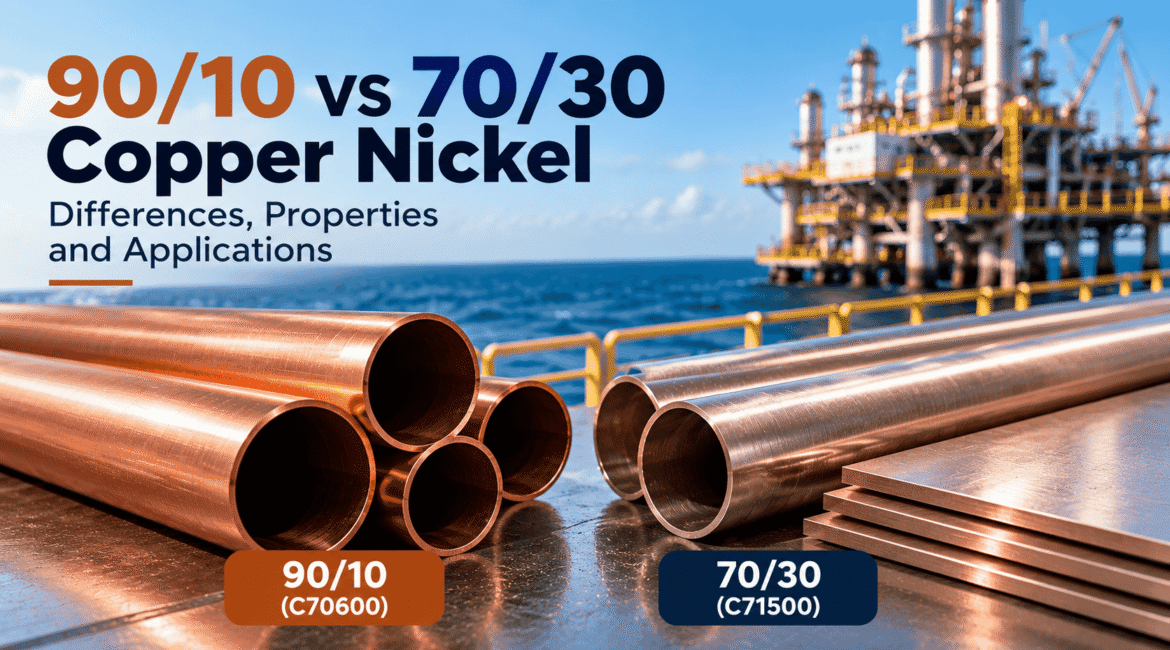
Copper-nickel alloys are widely used in demanding industrial and marine environments because they combine the useful properties of copper with the performance benefits provided by nickel and other alloying elements.
Two of the most widely recognized copper-nickel alloy families are 90/10 copper nickel and 70/30 copper nickel, commonly associated with UNS C70600 and C71500.
Although both belong to the copper-nickel family, they have different compositions and performance characteristics. Understanding the differences between 90/10 vs 70/30 copper nickel can help engineers and procurement teams select an appropriate material for tubes, sheets, coils, and other components.
What Is 90/10 Copper Nickel?
90/10 copper nickel is an alloy family consisting predominantly of copper with approximately 10% nickel, together with controlled quantities of other elements according to the relevant material specification.
C70600 is one of the most widely recognized UNS grades associated with 90/10 copper nickel.
It is commonly considered for marine, heat-transfer, piping, and industrial applications where corrosion resistance and dependable fabrication characteristics are important.
For tube requirements, buyers can review our C70600 90/10 Copper Nickel Tube and specify the dimensions and technical requirements needed for their project.
For additional technical information on copper-nickel alloys and their standardized compositions, refer to the Copper Development Association’s copper-nickel alloy data.
What Is 70/30 Copper Nickel?
70/30 copper nickel contains a higher proportion of nickel than 90/10 copper nickel. C71500 is a commonly specified grade associated with this alloy family.
Its higher nickel content contributes to differences in mechanical and corrosion-related characteristics, making the alloy relevant to demanding marine and industrial service conditions.
For projects requiring tubing, buyers can explore our C71500 70/30 Copper Nickel Tube and request material according to their required dimensions, quantity, and specification.
90/10 vs 70/30 Copper Nickel: Key Differences
The most obvious difference between the two alloys is their approximate nickel content, but this also contributes to differences in their overall performance.
| Feature | 90/10 Copper Nickel | 70/30 Copper Nickel |
|---|---|---|
| Common UNS Grade | C70600 | C71500 |
| Approx. Nickel Content | 10% | 30% |
| Copper Content | Higher | Lower than 90/10 |
| Corrosion Resistance | Excellent for many service environments | Suitable for more demanding environments |
| Mechanical Strength | Good | Generally higher |
| Common Applications | Marine, piping and heat-transfer equipment | Demanding marine and industrial equipment |
These comparisons are general. Actual material properties depend on the applicable specification, temper, product form, and manufacturing condition.
Corrosion Resistance
One of the primary reasons engineers specify copper-nickel alloys is their performance in corrosive environments.
Both 90/10 and 70/30 copper nickel are used in marine and water-handling applications. However, the correct material should be selected according to the actual service environment.
Factors such as water chemistry, temperature, flow velocity, pressure, equipment design, and the relevant engineering standard can influence material selection.
For this reason, choosing an alloy based solely on its nickel percentage is not recommended.
Strength and Mechanical Performance
Mechanical requirements are another important consideration when comparing C70600 and C71500.
The higher nickel content associated with 70/30 copper nickel contributes to characteristics that can make it useful for more demanding service conditions.
However, that does not mean C71500 should automatically be chosen for every application.
If C70600 satisfies the project’s mechanical, corrosion, and specification requirements, moving to a higher-alloyed material may add cost without providing a meaningful engineering advantage.
Heat Exchanger and Condenser Applications
Copper-nickel tubes are frequently considered for heat-transfer equipment, including certain heat exchangers and condenser systems.
When selecting material for these applications, engineers should evaluate factors such as operating temperature, pressure, water chemistry, fluid velocity, tube dimensions, and applicable industry standards.
Both C70600 and C71500 may be relevant depending on these conditions.
The final selection should therefore follow the equipment designer’s technical requirements rather than relying only on a general comparison of the two alloys.
Marine Applications
Copper-nickel alloys have a long history of use in marine engineering.
Depending on the material specification and operating environment, potential applications can include seawater piping, heat exchangers, condensers, cooling systems, and other marine equipment.
For procurement teams, simply requesting “copper nickel” may not provide enough information.
An RFQ should clearly identify whether C70600 90/10 copper nickel or C71500 70/30 copper nickel is required.
Copper Nickel Tube vs Sheet
Selecting the alloy is only one part of the purchasing decision. Buyers must also identify the required product form.
Copper Nickel Tube
Tube is commonly required for piping and heat-transfer applications.
When requesting copper-nickel tube, buyers should ideally provide the required alloy grade, outside diameter, wall thickness, length, quantity, applicable standard, and any testing or certification requirements.
Copper Nickel Sheet
Copper-nickel sheet can be required for fabrication, equipment manufacturing, and various industrial components.
For 90/10 sheet requirements, buyers can review our C70600 90/10 Copper Nickel Sheet and specify the required thickness, width, length, temper, and quantity.
Copper Nickel Coil
Coil material may be preferred for continuous manufacturing and fabrication processes. Width, thickness, coil dimensions, alloy grade, and quantity should be clearly stated when requesting material.
Is 70/30 Copper Nickel Better Than 90/10?
Not necessarily.
70/30 copper nickel has characteristics that can make it appropriate for demanding applications, but the more highly alloyed material is not automatically the better choice.
The objective of material selection should be to find the alloy that satisfies the project’s engineering and operating requirements.
If C70600 meets all applicable requirements, specifying C71500 simply because it contains more nickel may not provide a meaningful advantage.
Likewise, if the service environment or engineering specification specifically requires C71500, substituting C70600 purely to reduce material costs may be inappropriate.
How to Choose Between C70600 and C71500
When deciding between these alloys, buyers and engineers should consider several factors.
First, determine the exact material grade required by the drawing, specification, or equipment designer.
Next, evaluate the operating environment, including temperature, pressure, fluid characteristics, and corrosion conditions.
The required mechanical properties, product form, dimensions, fabrication process, applicable standards, and project budget should also be considered.
For critical applications, final material selection should always follow the appropriate engineering specification.
What Information Should You Include in an RFQ?
Providing detailed technical information makes copper-nickel sourcing much more efficient.
A complete RFQ should ideally specify:
- UNS grade, such as C70600 or C71500
- Product form, such as tube, sheet, or coil
- Required dimensions
- Quantity
- Applicable ASTM or other standard
- Temper or material condition, when relevant
- Testing requirements
- Certification or documentation requirements
For example, requesting simply “copper nickel tube” leaves several important questions unanswered. Specifying the exact grade, dimensions, standard, and quantity allows the supplier to understand the requirement much more accurately.
Final Thoughts
The main difference between 90/10 and 70/30 copper nickel begins with their alloy composition, particularly their nickel content, but material selection involves much more than composition alone.
C70600 90/10 copper nickel offers a useful combination of corrosion resistance, fabrication characteristics, and performance for many marine, heat-transfer, and industrial applications.
C71500 70/30 copper nickel contains more nickel and may be appropriate for more demanding service requirements where its particular characteristics are needed.
Neither material is universally better. The correct choice depends on the operating environment, engineering specification, required product form, dimensions, and overall project requirements.
For bulk copper-nickel requirements, contact Copper Cathode Supply with the required alloy grade, dimensions, quantity, product form, and applicable specification to discuss availability and quotation requirements.
Frequently Asked Questions
What is C70600 copper nickel?
C70600 is a commonly specified copper-nickel alloy associated with the 90/10 copper-nickel family.
What is C71500 copper nickel?
C71500 is commonly associated with the 70/30 copper-nickel family and contains substantially more nickel than 90/10 copper nickel.
Which is stronger, 90/10 or 70/30 copper nickel?
70/30 copper nickel generally offers higher mechanical strength, although actual properties depend on product form, temper, material condition, and applicable specification.
Can C70600 and C71500 be substituted?
They should not be substituted automatically. Any material substitution should be checked against the project’s engineering requirements, service conditions, and applicable standards.
Which copper nickel is best for marine applications?
Both C70600 and C71500 can be relevant to marine applications. The appropriate choice depends on the operating conditions, equipment design, engineering requirements, and applicable material standards.


